
This is a long-standing issue, but its noticeable effects seem to have become particularly apparent since the 2020s, at least in the discussions visible on social media and in certain newspaper articles.
One example is the study by Viji Diane Kannan and Peter J. Veazie, US Trends in Social Isolation, Social Engagement, and Companionship—Nationally and by Age, Sex, Race/Ethnicity, Family Income, and Work Hours, 2003–2020. In this study, which is not without methodological weaknesses, we find, in particular, this graph:
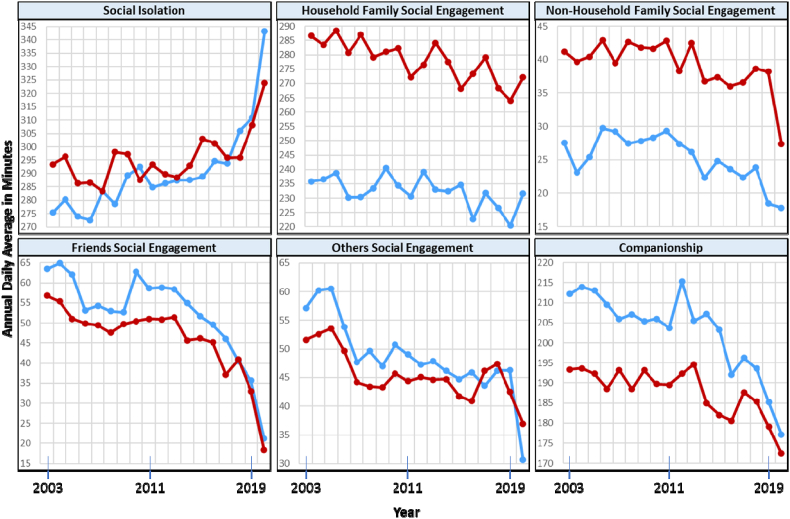
This figure shows a phenomenon of isolation shared by both men and women, although it is generally more pronounced among men.
On this point, the issue of men’s withdrawal and the way it seems to recur regularly in discussions (and not only in the United States) also raises the question of how people feel when they notice that men are less involved. Given the same timeframe, it is not certain that the absence of men or women is perceived in the same way, particularly in proportion to their functional importance within society.
The issue of causality in trends is also at stake. In the previous graph, we observe time lags in the trends, and we see in particular that men sometimes lead a trend, while at other times it is women. After counting the instances of one group leading the trend from one year to the next, we found no particular pattern between men and women on this point (8 for men versus 11 for women), although the mere possibility of a reciprocal influence between men and women in a socialization context is, of course, worthy of study.
Another document, published by the US Bureau of Labour Statistics in 2023 and entitled Labour Force Statistics from the Current Population Survey: Women in the Labour Force, shows us this figure:
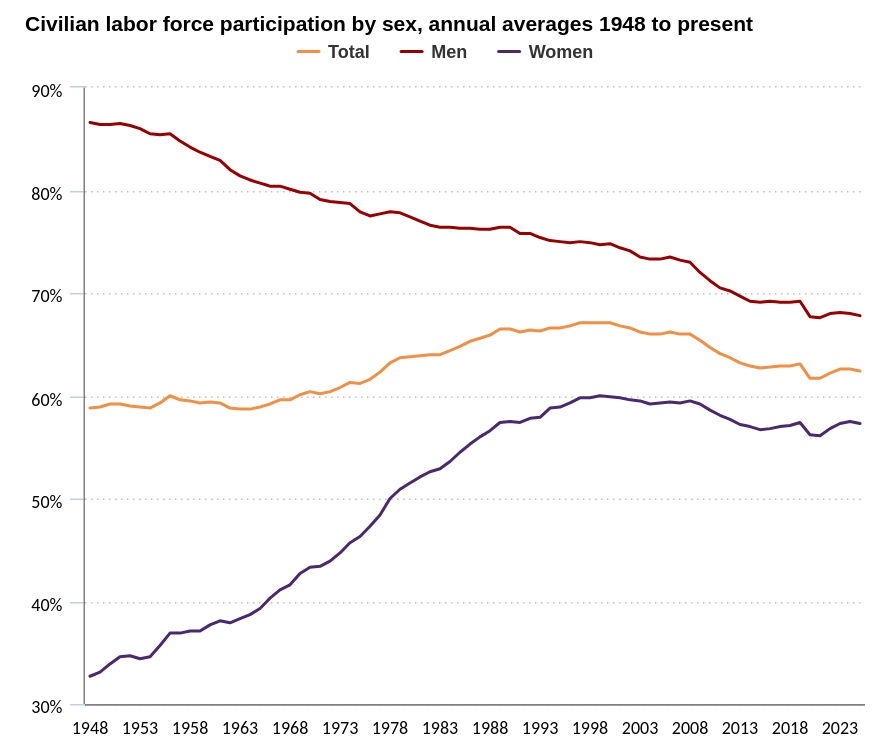
Here, we see a gradual replacement of men in the workforce by women, a trend that came to a halt in 1998. After 2008, we observe that employment patterns are the same for everyone, namely, apparently precarious.
This means that a growing number of men are no longer in the labour market. If we cross-reference this data with that on socialisation, we can see that, for the most part, these are not men devoting themselves to their families. They are simply men who no longer participate in civic life and who are certainly living on minimum social benefits.
Some studies also point to a deterioration in men’s health, which may sometimes render them unable to work. This area of investigation would merit a separate article.
In any case, the issue of men withdrawing from aspects of social life that require a significant commitment on their part is no minor matter. In fact, it is perhaps one of the most significant indicators for assessing the state of a society in terms of cooperation.
In this article, we will explain some basic concepts of ethology (the study of behavior), how it applies to men, and what we can infer from it. This is a thought-provoking piece, not without a slightly caustic tone.
The principle of reciprocity
In nature, which can be viewed as a dynamic principle seeking order (negentropy), there are many useful scales of analysis: an individual, a family, a community, a species, and so on. While each scale has its own distinct characteristics, they all share certain seemingly immutable traits.
The principle of reciprocity is one of them. This principle can be summarized as follows: any effort expended must yield a benefit greater than that effort. It is an extension of the fundamental principle of transaction, which is ubiquitous throughout reality (it is a fundamental law of physics).
The principle of reciprocity is inherent to life, for any organism that fails to secure beneficial gains for itself is doomed to disappear sooner or later. And this remains true regardless of the scale under consideration, from the individual to the whole of life, the latter always seeking to gain diverse and varied benefits from reality itself.
However, the principle of reciprocity is neither a simplistic nor an infallible phenomenon:
The expected benefit is a form of uncertain variable: it may be immediate and obvious, or delayed and questionable; we may even be completely mistaken and make an effort in vain, or make an effort in exchange for something that is harmful to us
What we identify as beneficial depends on our priorities, and certain things can be both beneficial and harmful depending on the context (eating for pleasure at the expense of one’s health, for example, or fulfilling a religious belief at the expense of one’s joy of life)
The recipient of the hoped-for benefit is not always oneself as an individual (making an effort for someone we love, such as a spouse or children, or for a project or an ideal)
This principle is binary when reduced to simple examples, but it can become infinitely subtle and complex in social contexts where interactions are multiple and interdependent. Reciprocity can thus become a culture that gives rise to habits, and it can also be expressed through interactions in which the efforts made and the benefits received are provided by people, whether consciously or not.
In the subject at hand, namely, men’s modern withdrawal, the concept of reciprocity is central.
The feminist shift
Nearly ten years ago, some of us made this observation: it’s surprising to see so few men attending village festivals or community events. Most of us were children in the 90s and we remember a community where men and women interacted regularly and where festive events brought both groups together in equal measure.
Later, we noticed an increasingly marked absence of men. When women would sometimes ask why they refused to participate in community life, responses like “I’d rather stay home in peace.” or “I still have things to finish.” were the most common. In reality, these men devoted significant time to solitary activities (hunting, fishing, tinkering, reading, gardening, etc.).
This solitary aspect of the male temperament is not a new discovery; it seems timeless, but it was its increase that struck some of us as significant. We therefore sought to understand what was happening and, above all, what had changed between the time when we saw men deeply engaged in social life and the time when we saw them withdrawing one after another.
Men are inherently evil
The practice of blaming men is nothing new; its spreading in the modern era dates back more than a century, but its widespread acceptance in society is, however, a relatively recent phenomenon. It seems that feminist propaganda has succeeded in its goal: to make people believe that all the problems facing society — or at least women, since men’s problems are almost never heard — are the fault of men. Male nature itself is a flaw, a disease.
From the time he is a young boy, a modern man internalizes, in ways that are more or less forceful, that he themselves is a problem, that his nature is a flaw, his instincts proof of his errors, his desires a source of shame, his aspirations delusions, and his idols monsters.
In short, he is worthy of ridicule and causes harm by the mere fact of existing. He is therefore expected to conform, to correct his instincts in order to mold his personality in the service of feminist society.
And he must hide his spaces for breathing and refuge, for if he needs them, it is because he is not yet fully reformed; he still harbors traces of toxic masculinity within him, traces he is supposed to be ashamed of and is supposed to fight against.
In short, modern society seeks to persuade men to hate who they are.
Men must apologize for existing as men
The immediate corollary of the guilty man is the repentant man. He is expected to make amends, to repair the damage he has caused, and to absolve his soul through sacrifice.
If the willingness to make sacrifices has been an essential part of man — and seems to have been so since the dawn of time — it no longer springs from within him but from others. Whereas men were once able to embrace tragic fates with a certain serenity because they seemed to promise to benefit what mattered most to them in the world, it is now feminist society that decides for them. Men must therefore prepare to make efforts where they previously did not: they must commit more to their partners and to women in general, making their lives easier as reparation for a hypothetical evil patriarchy. But they must also relinquish areas of endeavor they once valued. We no longer want them to voice their opinions on collective issues, such as politics or education, because they would then encroach on women’s territory and merely reproduce harmful, outdated patterns. Their opinions, in general, are no longer even welcome; they are masculine and therefore, in a way, somewhat flawed. We expect tolerance from them, and this quickly turns into submission.
As for the thankless tasks they’ve been saddled with for ages, they can keep them. Dying at work or in war is acceptable. And they must also continue to refrain from complaining, to keep silent about what they’re going through, because it’s insignificant anyway compared to women’s suffering, which is, in contrast, immeasurable.
Men are always wrong
Another hallmark of feminist society is expecting and demanding everything and its opposite from men. A man must be more involved in the home, but not all the time, because he must leave space for his wife. He must support her but not smother her, be present but not intrusive. In society, he must participate but say nothing and, above all, not complain. He must be courteous but not macho, proactive but not ambitious, protective but not paternalistic. His energy must be directed toward others, but he must also leave them alone. We need him to take initiative, but also to stop overshadowing others, especially women.
However, all these demands must be anticipated, and this without any means or tools to identify what others’ real needs might be. Moreover, the fact that men cannot guess what others need is another of their flaws, because they are, in fact, too selfish to manage it.
Men don't understand what is expected of them, and society itself no longer knows what it expects from men. But it doesn't matter; if this leads to misunderstandings or quarrels, it's because men have certainly gone wrong somewhere.
Moreover, if men suffer from what is asked of them, it is because they are discovering what it means to lose their privileges. In fact, men’s suffering in general is a just punishment for who they are and what they do.
Men must adore women
When men achieve something, it is because a woman has helped them. Their mother is a saint in this regard, since she brought them into the world. Their partner is a heroine, even when it might not seem so. The heroes and geniuses of the past actually obscure true heroism and true genius, which are feminine. Behind every great man, there is in reality a great woman.
The maternal instinct proves that the greatest love is that of a mother, not that of a father. A father’s love pales in comparison to a mother’s love for her children. A woman’s courage? A mother’s bravery? Rhere is nothing greater. True sacrifice is feminine. The purest and most selfless love is feminine.
Women are victims of men, even though they are so innocent and fragile. When a man touches a woman, he defiles her. His semen is itself a defilement, for a woman is a pure and divine being, and male sexuality is so vile and grotesque. A man who makes love to a woman is raping her.
A promiscuous woman is a free woman; a wicked woman is a wounded woman; a lying woman is a frightened woman; an incompetent woman lacks self-confidence; a violent woman is a woman who defends herself; a woman who kills her children does so to better protect them from their father.
The transactional break
The somewhat scathing presentation above of the state of affairs in society is not an artistic stance but an attempt to put into words what thousands of men might feel when confronted with the modern world. Everything written here has already been said or written by women about men. We have invented nothing, though we have spared ourselves the bother of linking to all the quotes in question.
Faced with all these demands and all this criticism (not to mention the outright hatred in many cases), many men have gradually changed their views on the issue of their engagement with society. In their eyes, society is becoming a hostile world, and they more and more participate in it only because they have no choice. Thus, men continue to work but no longer go the extra mile; they share common spaces but flee them as soon as possible and no longer communicate.
Smiling at a woman might be harassment; not smiling at a woman might be disparagement. Correcting a child might be violence; not correcting a child might be neglect. We don’t know; we no longer know.
Nature always seeks optimal transactional solutions, and when an action no longer offers a valid reciprocal, it tends to be abandoned or ends up killing the one who persists in performing it.
Some people, usually women, take offense that men no longer come to the aid of a woman who is being attacked on the street or on public transportation. The real question is rather this: why would they?
There is no such thing as an unmotivated action in nature. All actions make sense in some way, and a heroic man, a chivalrous man, is part of a society that values and celebrates him in return for his efforts and his willingness to take risks.
Coming to the aid of a woman who is being attacked puts your life at risk, that’s no small matter. But a society that expects men to be willing to sacrifice themselves under any circumstances while constantly telling them they’re worthless is, in reality, burying its head in the sand.
For men’s capacity for sacrifice is proportional to the importance they attach to what they are preparing to sacrifice themselves for.
A misandrist society is, of course, not loved by men. They find no sustenance, no joy, no hope in it. It is their enemy.
Thus, little by little, and in a completely predictable way, men are giving up one after another. They choose solitude and the last remaining spaces that are still somewhat masculine in order to be happy. Moreover, in the age of the Internet and video games, opportunities for solitary escape are relatively numerous and accessible.
For many men, interacting with the world has become synonymous with compromise. We consent to the effort of interacting with the world because we have no choice, but the joy of doing so has vanished.
Where companies had grown accustomed to working with men who were eager to go the extra mile, they now have to deal with men who do the bare minimum. Where women had grown accustomed to men courting them, they now have to deal with pragmatic men who have lost all sense of romance. They must also do without the spontaneous, daily assistance of men who were accustomed to generous courtesy.
Many children are also growing up without a father, either because their mother or the courts have separated them, or because their father has chosen to no longer expend his energy caring for them. And if he has abandoned his role, it is sometimes also because the mother of his children did everything she could to make that happen.
On that matter, one of our member has worked in the past with a family counsellor who assured him that 98% of the cases she dealt with stemmed from mothers refusing to let fathers play a part in bringing up the children, with the result that the fathers eventually stopped trying.
In reaction to men’s resignation, we see many people invoking moral notions on these subjects as sufficient justification for men to invest effort in this or that activity. But this is wishful thinking. In reality, morality cannot act on its own: it emerges from a society whose interactions it optimizes. A morality that tries to sustain itself even though it requires certain people to give everything without receiving anything in return inevitably breeds forms of tyranny and ultimately brings down the society in which it prevails.
Reward or disaster
Although the phenomenon of men “stepping back” is not yet widespread, it is undeniable and is gaining ground day by day. The effects are numerous. Women feel neglected and increasingly burdened by the weight of the work and responsibilities.
Men, for their part, are isolating themselves, sometimes happily, sometimes painfully. For them it is not always a source of fulfillment. Most people enjoy a vibrant social life, and virtual worlds do not yet replace this need, if they ever will.
But another problem is looming: since our society was built on the active, constant, and self-sacrificing participation of men, what will become of it if the majority of men no longer consent to participate?
In this regard, we can see two possible paths for modern society: either it persists in its injustice, turns into a tyranny, and collapses, or it rectifies its transactional proposals by offering men functional reciprocity: in terms of wages, friendship, affection, sex, family, reputation, autonomy, peace, etc.
Women will inevitably have a major role to play in this (and in many places, they are driven to this role by religious institutions), but it is not certain that a society correcting itself in this way after years of feminist drift will not have to go through a coercive phase.
In the end, it is predictable that modern society will eventually experience a period of violent patriarchal resurgence. The blatant asymmetry currently being imposed on men is beginning to show cracks, and it is predictable that the pent-up suffering of many of them will not find a truly peaceful resolution.